

In website SEO strategy, keyword research is an important step to help businesses understand what customers are looking for, thereby building appropriate content and increasing the ability to reach potential customers on Google. However, choosing keywords based only on emotions or high search volume does not necessarily bring business efficiency.
So how to methodically research SEO keywords, identify competitive opportunities and build a suitable content strategy? Find out with QWeb Design 6 steps to effectively research SEO keywords in the article below.
1. What is SEO keyword research?
SEO keyword research (Keyword Research) is the process of searching, analyzing and selecting words or phrases that users enter into search engines when they need to find out information, products or services.

This process helps businesses determine the topics that need to be deployed, understand customers' search purposes and choose keywords suitable for website development goals.
For example, a business providing website design services could research keywords such as:
- Professional website design.
- SEO standard website design.
- Design sales website.
- Business website design service.
- Full package website design costs.
Each keyword represents a different need. People searching for "what is website design" may be looking for knowledge, while people looking for "full package website design service" often need to consult a service provider.
Therefore, keyword research is not only about finding phrases with a lot of hits, but also about identifying the right keywords that match your target customers and business goals.
2. Why is keyword research important for website SEO?
An effective keyword research strategy brings many benefits to the business website development process.

2.1. Reach the right potential customers
Keywords help businesses understand user needs at each stage before making a purchase. When content addresses the right issues that customers care about, the website has a better chance of attracting relevant traffic.
2.2. Build a targeted content strategy
Instead of posting based on inspiration, businesses can rely on a set of keywords to plan content for service pages, product categories, blog posts and landing pages.
2.3. Optimize SEO resources
Analyzing search volume, competition level and search intent helps businesses prioritize keywords that are suitable for existing resources, limiting spread investment in keywords that are too difficult or do not bring business value.
2.4. Create a sustainable website development foundation
A set of properly classified keywords helps businesses build a logical website structure, link related content and develop a system of articles according to each topic.
3. Instructions on 6 steps of effective SEO keyword research
Step 1: Choose keywords related to products and services
First, businesses need to identify the keywords directly reflects the business field, products, services and needs of target customers.
You can start by answering the questions:
- What words do customers often use to find products or services?
- What problem are they facing and how do they want to solve it?
- What characteristics make customers choose a business?
- What information do customers often look for before making a purchasing decision?
Then, create an initial keyword list based on major topic groups.
For example, for a business providing website design services, the keyword list could include “business website design”, “sales website design”, “SEO standard website design” and “website design quote”. In this step, you should combine the main keyword with phrases that describe specific needs to expand the scope of your research.
Step 2: Find suggested keywords and check Search Volume
After having the initial keyword list, the next step is to expand the list and analyze monthly search volume (Search Volume).
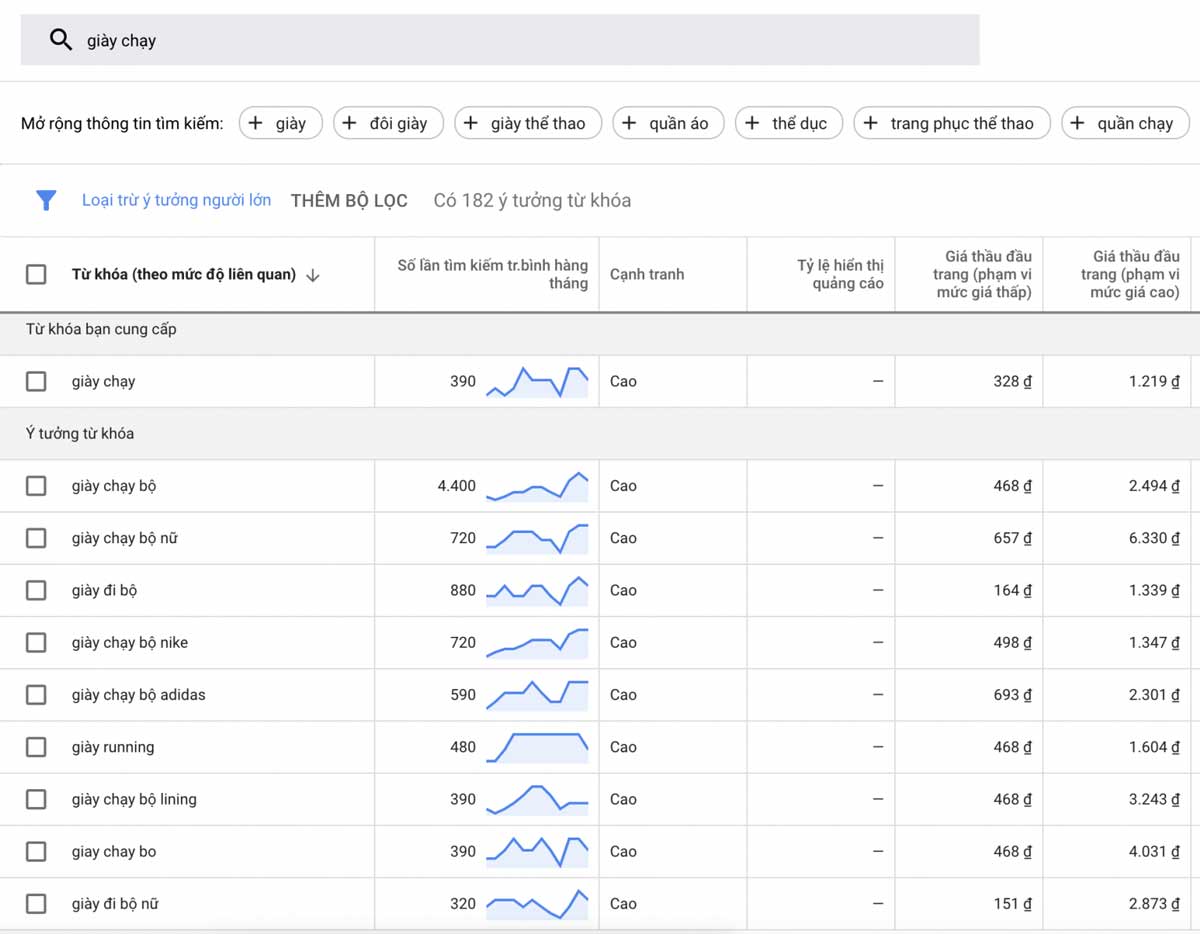
Some popular keyword research support tools include:
- Google Keyword Planner: Refer to search volume and explore related keywords.
- Google Search Console: Analyze actual queries that helped the website show up on Google.
- Ahrefs: Research keywords, analyze competitors and refer to keyword difficulty.
- Google Autocomplete and related searches: Discover expressions and topics of interest to users.
When analyzing Search Volume, you need to keep in mind that high search volume does not mean high conversion ability. A keyword that has a moderate search volume but clearly demonstrates a purchasing need is sometimes more suitable for business goals.
For example, the keyword "what is a website" can attract people who are looking for knowledge, while "website design for full sales" represents the need to search for more specific services. Therefore, evaluate Search Volume along with the relevance, search intent and business value of each keyword.
Step 3: Filter keywords according to SEO goals
When the keyword list has been expanded, you need to filter to retain keywords that are suitable for website development orientation.
Can be based on the following criteria:
- Relevance: Are the keywords suitable for your products, services and business field?
- Search Intent: Do users want to find out information, compare options or use services?
- Search volume: Does the keyword have interesting search demand?
- Keyword difficulty: Does the website have enough resources and competitiveness?
- Business value: Does the keyword have the ability to reach the customer group that the business wants to serve?
Besides, it is necessary to eliminate keywords that are not relevant, have different search intent than the expected content, or are unnecessary duplicates.
For example, if the website is aimed at customers who are in need of hiring a website design unit, you can prioritize keywords related to services, costs, features and implementation processes instead of focusing entirely on general knowledge topics.
Note that keywords should not be eliminated just because of low search volume. Long-tail Keywords often describe specific needs and can bring quality customers if suitable for the business service.
Step 4: Check Allintitle to see the level of competition
Allintitle is Google's search operator, allowing to find pages containing keywords specified in the title.
You can enter the following syntax into Google:
allintitle: sales website design
The returned results help refer to the number of pages whose titles contain the corresponding keyword phrase. This is data that can be used in the process of evaluating SEO opportunities.
However, it should be noted that the number of Allintitle results is not a complete or absolutely accurate measure of a keyword's competitiveness. Results may change over time and do not reflect the entire quality of the pages being ranked.
For a more realistic assessment, you should also check:
- The quality and depth of content are top-notch.
- The level of reputation and strength of competing websites.
- Relevance between existing content and search intent.
- User experience quality, page structure, and technical SEO factors.
Combining the above factors will help you have a better basis to decide which keywords to prioritize.
Step 5: Calculate KGR (Keyword Golden Ratio)
KGR (Keyword Golden Ratio) is an index used to refer to the SEO opportunities of some long-tail keywords, often targeting queries with low search volume.
The formula to calculate KGR is as follows:
KGR = Number of Allintitle results / Monthly search volume
In which:
- Number of Allintitle results: Number of pages returned when using the Allintitle operator for the keyword being researched.
- Monthly searches: Estimated average number of searches per month for the keyword.
According to common usage, keywords with KGR below 0.25 are often considered opportunities worth considering. However, this threshold is for reference only, not Google's official ranking standard.
Illustrative example:
Suppose a keyword has 20 Allintitle results and a search volume of 100/month.
KGR = 20 / 100 = 0,2.
With this result, keywords below the 0.25 threshold are often referenced when screening for SEO opportunities.
However, you should not decide to deploy based on KGR alone. Combine this index with the quality of your competitor's content, keyword relevance, search intent, and the website's ability to meet user needs.
Additionally, ensure Allintitle and Search Volume data are collected in a consistent manner. For keywords with zero search volume or very low data, KGR may be meaningless or misleading.
Step 6: Classify and group keywords
After completing the research process, classify keywords into topic groups and search intent groups to build an SEO content plan.
You can divide keywords into basic groups:
Informational keyword group: Users want to gain knowledge or have their questions answered.
For example: "What is a standard SEO website", "how to optimize website SEO", "What is keyword research".
Commercial keyword group: Users are researching and comparing solutions before choosing.
For example: "reputable website design unit", "which sales website should I choose", "professional website design service".
Group of transaction keywords: Users express their need to use services or purchase products.
For example: “website design quote”, “package sales website design”, “rent a business website design”.
Then, sort the keywords by topic, determine the appropriate landing page and plan the content deployment.
A group of keywords with the same search intent can often be developed on the same page. Conversely, if queries represent different needs, you should consider building separate pages to better meet user expectations.
Proper grouping helps limit the number of pages on the same website competing for a similar query, while also facilitating the development of internal linking and a clear content structure.
4. Things to note when researching SEO keywords for business websites
For the keyword research process to bring real value, businesses need to avoid some common mistakes.
Only focus on keywords with high search volume
Keywords with large Search Volume often attract a lot of interest but may be highly competitive or not suitable for conversion goals. Balance between main keywords, long-tail keywords and queries that demonstrate the need to use the service.
Ignore user search intent
Content needs to match actual search intent. If a user wants to see a price list but the website only provides theoretical articles, the ability to meet their needs will be limited.
Depends entirely on the stats
Search Volume, Keyword Difficulty, Allintitle and KGR all have certain limits. There is no single index that ensures a keyword will reach the top of Google.
Not updating the keyword set periodically
Customer needs, market trends and search results may change over time. Businesses should regularly monitor data from Google Search Console, evaluate content effectiveness and update keyword lists when necessary.
5. QWeb Design – SEO standard website building solution for businesses
Keyword research is an important foundation of SEO, but to effectively exploit keyword sets, businesses also need a website with a reasonable structure, good loading speed and the ability to develop long-term content.
QWeb Design provides professional website design services, aiming at SEO optimization and supporting businesses to develop their business activities in the online environment. Website is built with a multi-device compatible interface, supporting tools like Google Search Console and Google Analytics, helping businesses track performance after deployment.
When building a website, businesses should pay attention to the following factors:
- Clear website structure: Divide categories, service pages and articles according to appropriate topics.
- On-page SEO optimization: Set up reasonable URLs, titles, headings, content and internal links.
- Page loading speed: Optimize images, source code and necessary resources.
- Mobile Visibility: Make sure the website is easy to use on phones, tablets and computers.
- Content expandability: Support adding blog posts, service pages and landing pages according to SEO plan.
Note that SEO standard websites create a favorable foundation for the optimization process, but Google rankings also depend on content quality, level of competition, website reputation and many other factors.
If your business is planning to build a new website or improve its current platform, please refer to the services at QWeb Design to choose a solution that suits your needs and budget.