

Are you planning to make a website for your business but don't know where to start? Many people often think that they just need to find a website design unit, choose the interface and then proceed. However, if not fully prepared from the beginning, the implementation process may arise many problems such as lack of content, structural changes, extended time or additional costs.
Before hiring a website designer, businesses should prepare at least the 6 elements below to make the website making process faster and more effective.
1. Prepare a brand identity
Website is one of the important touch points that help customers identify businesses in the digital environment. Therefore, before designing your website, you should prepare brand-related documents such as:

- Logo and logo version used on light and dark background.
- Main colors of the brand.
- Fonts.
- Identification image.
- Slogan or brand message.
- Brand guideline if the business already has one.
These elements help designers build a website interface consistent with the brand image instead of using a pre-existing design that lacks uniqueness.
2. Choose a suitable domain name
Domain name is the address for customers to access the website, for example qweb.com.vn.
When choosing a domain name, businesses should prioritize names:
- Short, easy to remember.
- Brand related.
- Easy to read and easy to enter.
- Limit confusing characters.
- Suitable for long-term development orientation.
If your business already has a brand name, you should check and register the domain name as soon as possible to limit cases where a suitable domain name has already been registered.
3. Determine what features the website needs
Not all websites need the same features.
A business introduction website may only need basic functions such as:
- Introducing the business.
- Products/services.
- Project or portfolio.
- News/blog.
- Contact form.
- Google Maps.
- Call, Zalo or Messenger button.
Meanwhile, sales websites may need to add:
- Product categories.
- Cart.
- Online payment.
- Order management.
- Customer accounts.
- Discount code.
Therefore, before designing a website, clearly determine what the website is created for and what actions customers need to take on the website. Identifying features from the beginning also helps the design unit quote the website price more accurately and limits arising during the implementation process.
4. Build sitemap and website structure
A fairly common mistake when making a website is to start designing the interface before determining the content structure.
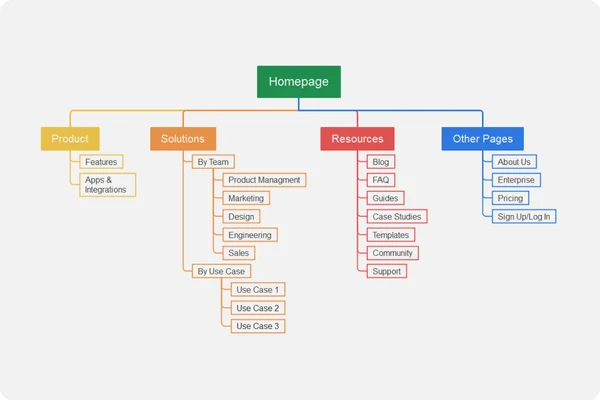
Instead, businesses should build a website sitemap first.
For example, a business website might include:
Home – Introduction – Products/Services – Projects – News – Contact
From this overall structure, the design unit can determine:
- How many pages does the website have?
- Which page is the most important?
- How should the menu be arranged?
- How will users move between pages?
- Which content should be prioritized?
One sitemap clearly not only makes the website easier to use but also creates a good foundation for website UX/UI and SEO.
5. Prepare images, videos and content
No matter how beautiful a website is, it is difficult to make an impression if the content inside is sketchy.
Before starting a website, businesses should prepare:
- Corporate image.
- Product/service images.
- Project images.
- Introduction video.
- Business information.
- Product/service content.
- Contact information.
- Certifications, awards or achievements, if any.
In particular, if the website has Google SEO goals, the content should be prepared and built based on customers' search needs instead of just providing business introduction information. The clearer the content, the easier it is for the designer to build a layout that suits the user experience.
6. Determine the person in charge of the website
Finishing a website doesn't mean the work is over. After the website is put into operation, businesses still need to update:
- New products and services.
- News.
- Images.
- Project.
- Promotion information.
- SEO content.
- Contact information.
Therefore, businesses should determine in advance who will manage and update the website. If you do not have specialized personnel, you can talk to the design unit about administration instructions, content support or website maintenance.
Why should you prepare before making a website?
Prepare carefully before hiring a website designer to help businesses:
- Save time: The design and development team has enough information to start the project.
- Editing restrictions: Structure, features and content are clearly defined from the beginning.
- Cost control: Limit requests arising outside the original scope.
- Increase website efficiency: Website is built based on business goals and customer needs instead of just focusing on the interface.
- Easy to develop later: A good website structure will be more convenient when expanding with new content, products or features.
Should you make a website right away if you haven't prepared enough?
It is not necessary to prepare everything perfectly before starting. However, businesses should identify at least 4 important factors:
What goals does the website serve – Who are the customers – What pages/features does the website need – What are the existing content and resources.
From there, the website design unit can work with the business to complete the missing parts in the implementation process.
QWebDesign – Website design according to business goals
An effective website not only needs to be beautiful, but also needs to be consistent with the brand, easy to use and serve the right business goals. At QWebDesign, the website deployment process is built from understanding needs, structural orientation, UI/UX design to website development and optimization.
If you are planning to make a website but don't know where to start, prepare the basic information above and talk to the design unit to get advice on suitable solutions.
QWebDesign – Full package website design, accompanying businesses to build a professional presence in the digital environment.