
In the online business environment, customers increasingly want to find information quickly and receive timely support. However, not all businesses have enough personnel to provide continuous consultation, especially outside working hours. This is one of the reasons why websites have AI chatbots has become a solution that many businesses are interested in.
Not only does it support answering questions, AI chatbots can also help customers learn about products, choose services and connect with the consulting team more conveniently. So how does an AI chatbot on a website work and what benefits does it bring to businesses?
1. What is AI Chatbot on website?
AI Chatbot on website is a conversation tool integrated into the website, using artificial intelligence to receive and respond to user questions through a chat interface.
Unlike traditional chatbots that mainly operate based on pre-set scenarios and keywords, AI chatbots can use natural language processing technology to understand requests and create responses that are more appropriate to the context.
Depending on the technology and implementation, AI chatbots can support many activities such as:
- Answer frequently asked questions about products and services.
- Provide information about prices, policies and working procedures.
- Guide customers to find information on the website.
- Collect consulting needs and contact information.
- Assist customers in choosing suitable products or services.
- Forward complex requests to the staff in charge.
For example, when a customer visits the website of a website design unit and wants to find out the cost of building a sales website, an AI chatbot can provide information about factors affecting the price, introduce related service packages and guide the customer to send a quote request. Thanks to that, the website not only plays the role of introducing the business but also becomes a direct interaction channel with customers.
2. 6 benefits when integrating AI chatbots into business websites
2.1. 24/7 customer support
One of the outstanding benefits of AI chatbots is the ability to receive and respond to customer requests outside of working hours. While the consulting team cannot be online continuously, chatbots can still assist in answering common questions based on established data and information scope.
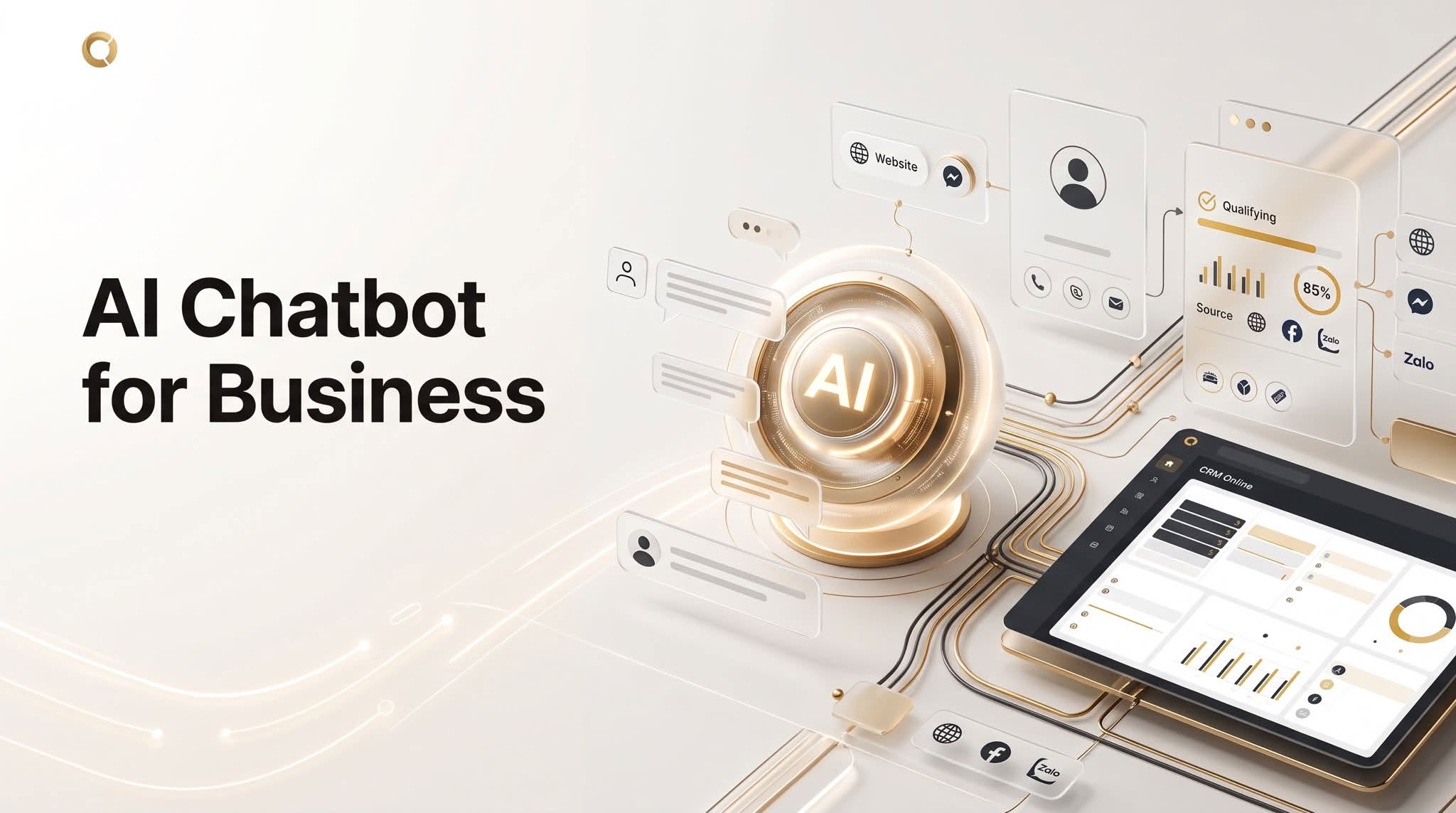
For example, customers accessing the website in the evening can learn about services, conditions of use, ordering process or basic information without having to wait until the next working day. This is especially useful for online businesses, service providers and businesses with customers accessing their websites at different times.
However, chatbots can only provide effective support when properly configured and have an accurate enough data source. Complex issues may still require staff intervention.
2.2. Provide information quickly and conveniently
When accessing a website, customers often want to find answers to specific issues such as product price, service characteristics, implementation time or warranty policy. If information is distributed across many pages, users may waste time searching and easily leave the website without finding the necessary content.
AI chatbots help simplify this process by receiving questions directly and providing answers based on information established by the business or data sources that the system is allowed to use.
For example, with a website providing website design services, chatbots can guide customers to learn:
- Types of business websites, sales websites and service introduction websites.
- Features that can be integrated into the website.
- Process of receiving requests and implementing projects.
- Factors affecting website design costs.
- Contact channel to receive detailed advice.
When combined with a clear website structure, chatbots help customers access information more conveniently, while reducing unnecessary search operations.
2.3. Support collecting leads
A website with high traffic does not necessarily generate many potential customers. One of the reasons is that users may be interested in a product or service but do not know the next step to take. AI chatbots can contribute to solving this problem by proactively supporting customers in the process of researching and making choices.
For example, chatbots can ask basic questions to determine user needs:
- What product or service are you interested in?
- Do you need a business introduction website or sales website?
- In what time period do you plan to deploy the website?
- Which channel would you like to receive advice or receive a quote through?
Based on the answer, the system can guide customers to the appropriate service page or offer to leave contact information if they need in-depth advice. When integrated with a customer management system (CRM) or appropriate data storage tool, chatbots can also assist in transferring information to the sales department. Thanks to that, businesses have more opportunities to reach customers who are truly interested in the product or service.
Note, information collection needs to be done transparently, with an appropriate basis and in compliance with regulations on personal data protection.
2.4. Personalize customer experience
Each customer accessing the website may have different purposes. People who want to buy products need information about pricing and how to order, while people looking for business services may be interested in implementation processes, implementation capacity, and completed projects. AI chatbots can use information in the conversation to tailor responses to each user's specific needs.
For example, when a customer says they are looking for a solution to build a sales website, the chatbot can prioritize introducing features such as product management, shopping cart, online payment and order management.
On the contrary, if the customer needs a business introduction website, the system can focus on the brand interface, introduction page, service catalog, typical projects and contact form.
This approach helps the conversation become more relevant to actual needs, instead of providing the same content to all visitors. However, the level of personalization depends on the chatbot's capabilities, the data provided, and the information the user shares.
2.5. Optimize consulting process support
For businesses that receive many requests via the website, consultants may have to spend a considerable amount of time answering repetitive questions. AI Chatbots can assist in handling common requests such as service introductions, process instructions, policy explanations, or providing basic information. Thanks to that, the human resources team can focus more on tasks that require expertise, such as consulting solutions, handling special requests and negotiating with customers.
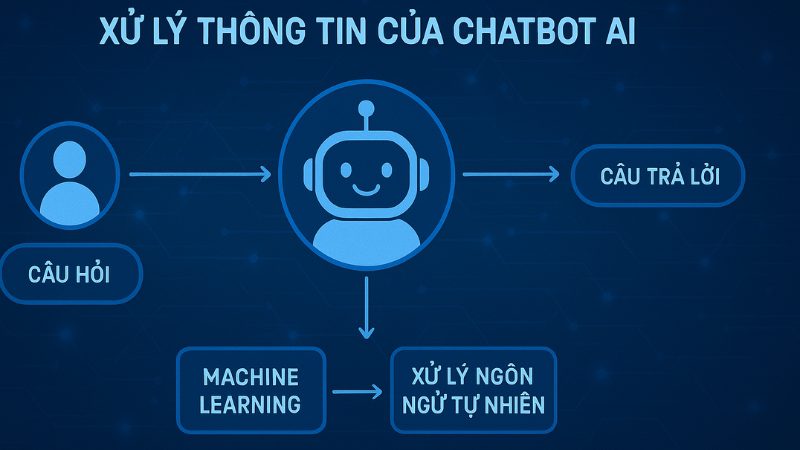
Businesses can also set up a conversation transition mechanism when the chatbot does not have enough information to answer or when the user wants to work directly with the employee. It should be noted that chatbots do not automatically replace the customer service team. Actual effectiveness depends on the number of questions, data quality, integration capabilities and coordination processes between the automated system and human resources.
2.6. Support to improve the conversion ability of the website
The goal of a business website is not only to attract visits but also to direct users to valuable actions, such as sending a quote request, signing up for a consultation, placing an order or contacting the business. AI chatbots can support this process by answering hesitant customer questions, providing relevant information, and guidance on next steps.
For example, when a customer is looking into website design services but does not know which solution to choose, the chatbot can ask about business goals, website type and necessary features to guide the initial choice. The system can then lead users to the corresponding service page or suggest connecting with staff for detailed advice.
When deployed properly, chatbots can contribute to reducing obstacles in the process of understanding a service and creating favorable conditions for customers to perform the desired action. However, chatbots do not guarantee increased conversion rates in all cases. Businesses should track metrics such as conversation initiation rate, consultation requests, form completion rate, and conversion rate to gauge actual effectiveness.
3. Which website should integrate AI chatbot?
Not every website needs an AI chatbot. Integrations should be based on business goals, customer behavior, and actual support needs. Below are some types of websites that can consider implementing this solution.
Sales website
E-commerce websites often have many questions related to products, prices, payment methods, delivery and returns. AI Chatbot can help provide information, guide customers to find products and answer common questions during the shopping process.
Business introduction website
For business introduction websites, chatbots can help customers learn about the field of operation, service list, contact information and content related to cooperation needs. This is a solution worth considering for B2B businesses or units with relatively complex consulting processes.
Website providing services
Businesses operating in the fields of design, marketing, technology, education or consulting can use chatbots to receive needs and guide customers to learn about services. For example, a website design website can integrate a chatbot to help customers determine the appropriate type of website, learn about necessary features, and submit a quote request.
Website to schedule and register for consultation
For websites that provide services by appointment, chatbots can help explain the registration process, provide necessary information, and guide users to the booking form. If connected to a suitable scheduling system, the chatbot can also support lookups or perform some operations according to granted permissions.
Regardless of the type, businesses should clearly determine the purpose of using chatbots before deploying to avoid incurring costs but not bringing adequate value.
4. What should you keep in mind when integrating AI chatbots into your website?
For AI chatbots to work effectively, businesses need to pay attention to a number of important factors during the deployment process.
4.1. Determine intended use
Before choosing technology, businesses need to determine what the chatbot is used for: answering questions, supporting product searches, receiving potential customers or supporting customer care. The clearer the goal, the easier it is to select features and evaluate effectiveness.
4.2. Prepare accurate data
The quality of the answer depends significantly on the data and system configuration. Businesses need to prepare information about products, services, policies, working procedures and frequently asked questions. Important content such as price list, conditions of use and warranty policy need to be updated when there are changes.
At the same time, it is necessary to establish a handling mechanism when the chatbot cannot find suitable information, instead of letting the system give unfounded answers.
4.3. Ensure compatibility with website
Chatbot needs to be properly integrated with the website platform, interface and existing functions. Businesses should check visibility on computers and mobile devices, page load speed, ease of use, and connectivity with related tools.
A chatbot that has many features but makes the interface difficult to use or significantly affects website performance can create an undesirable experience.
4.4. Pay attention to security and privacy
If the chatbot receives contact information, customer data or private communications, businesses need to clearly define what data is collected, the purpose of use and how it is stored. Besides, it is necessary to check the data processing policy of the chatbot provider, system access rights and appropriate information protection measures.
Businesses should also limit asking users to provide unnecessary sensitive information during the chat process.
4.5. Maintain support from staff
Although AI chatbots can automatically handle many requests, there are still situations that require direct human assessment and support. Therefore, the website should provide a clear contact method so that customers can switch to talk to staff when necessary.
This is an important factor that helps businesses maintain consulting quality, especially with complex requirements or that have a direct impact on purchasing decisions.
5. Can a website with an AI chatbot replace a consultant?
The answer is not quite. AI Chatbots are suitable for tasks that are repetitive, require quick responses or are based on provided information sources. Meanwhile, consultants still play an important role when customers need in-depth solutions, negotiate cooperation conditions or handle special situations.
Instead of viewing AI chatbots as a tool to replace all human resources, businesses should consider this as a solution to support the customer interaction process.
A reasonable deployment model might include three steps:
- Chatbot AI receives requests: Record questions and identify initial customer needs.
- Information provision system: Answers common questions, provides guidance on understanding the service, and supports next steps.
- In-depth request reception staff: Advise on appropriate solutions, handle complex situations and support customers in making decisions.
This combination helps businesses take advantage of automation while still maintaining the human role in activities that require expertise and flexibility.
6. QWebDesign – Build websites that suit business needs
An effective website needs more than a beautiful interface. From information architecture, user experience to the ability to integrate support tools, each factor needs to be considered based on the business's operational goals.
With the orientation of designing websites to serve business needs, QWebDesign aims to build an online platform to help businesses introduce their brands, present products and services, and create favorable conditions for customers to learn and connect.
Depending on deployment goals, businesses can consider integrating AI chatbots to assist in answering questions, receiving consultation requests and improving interactive experience on the website. Before deployment, QWebDesign recommends that businesses clearly define their usage needs, data sources for chatbots and functions that need to be integrated to choose the appropriate solution.
Are you looking to build a new website or upgrade an existing website with customer support features?
Contact QWebDesign to discuss needs and find website solutions suitable for the development orientation of your business.